The CLI we need
Publish date: 2026-08-18
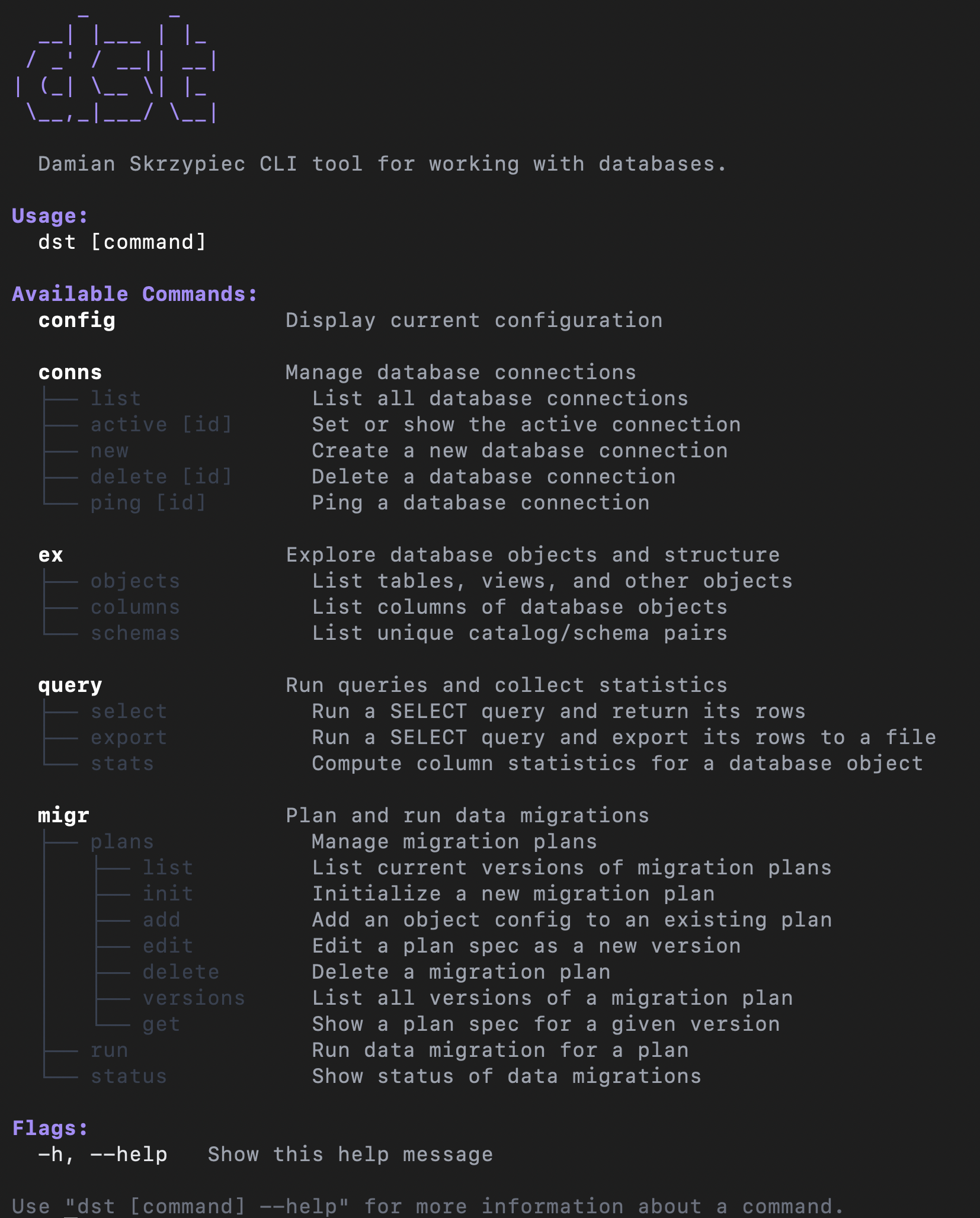
Current commands in dst
Intro
For a long time I've wanted to consolidate my practices and methods around working with data and designing database schemas from the backend perspective, but back then I didn't know yet in what form I'd like to materialize it. Should it be a library, a methodology, a CLI, or maybe a full platform with a graphical or web interface? Each of those options had its own set of pros and cons. At that time I didn't have a concrete vision yet, just a general feeling and desire, so it ended up going nowhere.
In the first months at ConnectyAI I faced the problem of designing and implementing an interface which would let the application backend connect to a given set of data sources, such as Postgres, BigQuery, Snowflake, Redshift, etc. That interface and the corresponding implementations supported functionalities like schema inspection, query execution, listing query history, and so on. After this experience my aforementioned feeling only got stronger. Moreover, I gained an intuition on to what extent a consistent interface for many data sources is possible and useful.
Another important event was the moment when the agentic approach to LLMs became very useful in practice (since the times of Claude Code and improved LLM models).
So what do we need?
So far I haven't said anything concrete. That's because I wanted to structure this post according to the chronological order of my experiences and actions.
So what do we need (in this context)? We need software which:
- reflects my practices and methods for working with data
- enables LLM agents to work according to the previous point
- supports many different data sources and is open for extensions
The beginning, of course, was writing specialized agents and skills in Claude Code, which would reflect my most common tasks around data. It was an improvement, but maintaining and evolving those entities turned out rather mediocre. Moreover, passing data sources and potentially secrets could be done comfortably only in non-production environments. So I abandoned this approach.
As it turned out very quickly, the agentic approach to LLMs benefits a lot from using CLI tools. Well-known CLIs/SDKs are obviously baked into the models, but even in case of niche or new programs, agents are able to quickly scan the documentation and build up the context. Locally, programs allow for a very fast feedback loop, which converges to agents understanding the given tool.
At this point I decided that a CLI program is the perfect form for my tool for working with data. A deterministic program which allows fundamental operations on many data sources through a consistent abstract interface with rich documentation will be a perfect foundation for LLM agents. Something that once would be a rather awkward CLI interface, which most programmers wouldn't use willingly, now becomes a layer which agents use without any problem, based on a high-level task.
Moreover, having the mentioned CLI between a human and LLM agents lets us
introduce safety measures which wouldn't be possible when using agents
directly. One example is access to data sources. In this case they are
always defined by a human and secrets are never available to the agent. It
can only use specific CLI commands and build solutions or analyses on top
of them. What's more, the agent will never be able to delete
(DROP) or modify (UPDATE) data which lives under
the given connection (dst conns). The CLI simply doesn't
support such operations, which is a limitation, but on the other hand it
provides safety. It's my preference and a conscious tradeoff.
Yet another advantage of a CLI is the fact that I don't have to spend time on designing and implementing intermediate graphical or web interfaces, which is usually a hard and time-consuming task, if we want to do it properly. So I can focus on designing and implementing the essential functionalities.
We?
We? Meaning who? By "we" I mean myself and LLM agents that will be using this CLI.
It might turn out that, by accident, this tool will be useful also for others, but in the near future I don't plan to publish it. I use the mentioned CLI actively and even at the current early stage it's very useful, but it's not yet close to the scope of functionality I have planned.
dst
As you can see on the screenshot, I named the CLI dst, which
stands for Damian Skrzypiec Tool. This requires a bit of
explanation. My name is there not because I'm the author and I want to
remind users who created the tool, but for two reasons. The most important
one is the fact that I didn't have any other idea, and the second one is
to emphasize that it's a tool which reflects my preferences and
conventions.
After some time dst became just a three-letter word, an
alias, which doesn't need to have any other meaning than a reference to
the tool. Just like git. The origin of the name doesn't
matter here, neither does its expansion.
Current features
Currently dst supports the following families of commands:
-
dst conns- for creating and managing connections to data sources. At the momentPostgres, BigQuery, Snowflake, SQLite, CloudWatchLogsare supported. Connection secrets are stored in the system keyring, thanks to the go-keyring library. -
dst ex- for exploring data sources. It allows schema inspection, listing objects (tables, views, etc.), columns, data types, and so on. -
dst query- for executing, exporting, and other functionalities related to queries. It also includes computing statistics for a given set of columns of a given object.
Current usage
Currently I use dst mainly as a tool in Claude
Code (CC), where additionally I have a CC SKILL which
contains my preferences regarding formatting SQL queries and a high-level
strategy of using dst (the details of dst the
agent takes directly from the documentation).
My current main scenarios of using dst in cooperation with LLM agents are:
- Ad-hoc text-to-SQL - the simplest usage.
dstalone enables deeper context of object metadata and statistics of key columns. Based on this context the agent can generate better SQL queries. Moreover, the fact thatdstsupports many different data sources allows the agent to generate SQL queries for many data sources in a single session. An example might be an analytical query on both test and production environments, where schemas might slightly differ (because there was no deployment yet). - Developing data models - in this scenario I usually
have a data model defined in a repository. Extending existing models
or adding new ones would be possible just through cooperation with an
LLM agent. In practice, however, it's worth confronting the designed
entities with the actual data. An agent using
dstcan perform such tests on a set of given connections and aggregate the results in the form of a report. That in turn is an input for the next iteration of improving extensions in the data model. Based on my experience I can say that it brought a lot of value and saved a lot of (human) time. - Developing and debugging backends - very often
backend services are, in some part, a layer of abstraction over shared
and durable application state, which is quite often represented by a
database. In such a setup it's natural that an LLM agent working on
backend problems (in a session and backend repository) would benefit a
lot from the additional context of those databases. One example is
developing the schema of an operational database and generating
migration scripts between versions. Another very useful application,
especially if the backend is a distributed system, is the ability to
debug problems where the LLM agent can correlate the source code with
the actual data in the database. What's more, we can enrich our
context with operational logs of processes (
dstsupports AWS CloudWatch asdst conns). In such a situation the agent (and the programmer) have at their disposal everything that's needed to understand the problem and solve it. - Easy operations on many data sources - it doesn't
sound like something hard and in fact it isn't, but in practice it's
often quite irritating. For example, I have
Nclients, each one in BigQuery, but in a separate project, each with an identical or very similar data schema. I'd like to run an analysis across all clients. In the past that would require at least writing a script, handling many secrets, then executing queries and summarizing the results. Usingdst, an agent can inspect schemas for each client on its own, execute appropriate queries, and then aggregate the results in the form of a report. In practice it's very useful and saves a lot of time.
Planned features
As you can see on the initial screenshot, I've already planned adding the
dst migr command, which will be used for planning, executing,
and tracking data migrations between two data sources defined as
dst conns. The idea is as follows. We create a migration plan
- a list of objects together with various properties regarding the
migration (how the data should be split into smaller chunks, how much we
can parallelize reading, etc.). The default plan will be generated
automatically, based on the source and target schemas. Then, however, a
human or an agent will be able to analyze the default proposal and
introduce improvements. In the world of data things can vary a lot, so I
want to be prepared for possibly high flexibility of the process. Based on
the plan, the planned "chunks" of data will be prepared for each of the
objects. All this metadata will be stored in a local SQLite. This will
give us the ability to track migration progress and to eventually stop and
resume the process at any moment.
Planned, but not yet implemented, is the functionality for listing and searching historical queries for a given connection. It's a much smaller feature than migrations, but very useful in practice. It should be added soon.
Summary
Despite the early stage of development, dst is already very
useful. I plan to keep developing it, so that it supports the vast
majority of my work around data and systems operating on data. Over time
I will certainly try to add support for more data sources. I'd like
dst to aggregate my knowledge about a given data source and
its characteristics through the implementation of a shared interface,
properly covering possible differences and peculiarities.
Regarding publishing dst, I can't promise anything. The future will tell.